
All about time management
All about time management
Allocate, plan, and prioritize
Allocate, plan, and prioritize
We discover what's behind effective time management at work: the art of balancing the workday to maximize performance and well-being.
Time management at work goes beyond organizing tasks. Using time efficiently is the key to unlocking employees' potential, as well as achieving a balance between professional effectiveness and personal well-being.
What is time management?
What is time management?
Optimizing time means committing to an efficient allocation and planning of tasks throughout the day, prioritizing each of the activities to be performed according to their importance and urgency.
It's not about simply completing more tasks, but doing so strategically. Effective time management at work is, therefore, a fundamental skill that directly impacts productivity and the well-being of employees.
The key to the success of this practice lies, to a large extent, in the ability to identify crucial tasks, allocate adequate time to them, and maintain the flexibility to adapt to unexpected changes. Working faster can optimize time, but the real purpose of using time management strategies and tools is to work smarter, maximizing efficiency and minimizing the stress associated with the backlog of tasks.
Learning to optimize time doesn't just improve productivity, it also transforms the way we face daily challenges in the work environment. Helping decision-making, improving the work environment, and reducing work stress are just some of the advantages of an increasingly widespread practice among professionals and companies.
Benefits of good time management at work
Benefits of good time management at work

Effective time management allows the optimization of work hours which, in practice, translates into an improvement in performance. The planning of tasks and the use of tools to manage time play a key role in this point. Beyond facilitating proper organization - by marking time or setting priorities, for example - they help reduce procrastination and, consequently, boost productivity.
Moreover, completing tasks efficiently brings personal satisfaction, a sense of achievement and fulfillment that translates into greater employee motivation and belonging to the company. At Repsol, for example, we are committed to creating dynamic environments, implementing resources and actions designed to promote collaboration, agility, and productivity in increasingly advanced digital environments that offer our employees real possibilities for development and new professional challenges.

When tasks are allocated equally and deadlines are met, pressure on workers is reduced. This promotes collaboration and mutual support in the team, creating an environment where every member can concentrate on significantly contributing to the project. In other words, effective time management facilitates a more positive work environment.
The distribution and planning of tasks also allows more time for reflection and the generation of new ideas, i.e., for innovation and creativity. And not only that. With clear planning, making informed decisions becomes a smoother and less burdensome process.

One of the most evident benefits of correct time management is stress reduction. Distributing tasks throughout the day, week, or time frame chosen in each case, instead of accumulating them before the deadline for the delivery of a task or project, allows for a calmer and more reflective approach. Reducing that feeling of not having time or the anxiety of not making it, through planning and the use of time management tools, improves the quality of work.

Talking about effective time management is also talking about well-being. Being aware of how we spend our time in general, and our workday in particular, lays the foundations for proper task planning. In the new scenarios of remote work or flexible work hours -which we have been practicing for some time in our company, promoting a balance between personal and professional life, based on responsibility, autonomy, efficiency, and joint work-, prioritizing tasks, eliminating those that are unnecessary, or setting limits improves the quality of life at and outside work.
By preventing the backlog of tasks, time is freed up for leisure, family, or simply rest, emphasizing that time management is not only a tool for success at work, but also a key driver of personal satisfaction and well-being.
Work at Repsol
Join our team, and discover a job where you can train and develop as a professional.
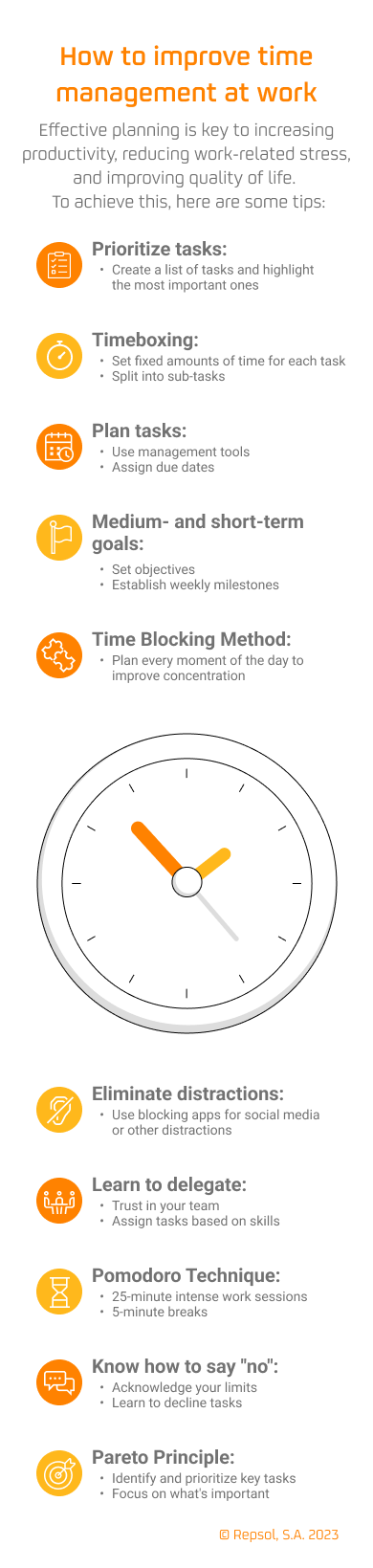
10 tips or techniques to optimize time management at work
10 tips or techniques to optimize time management at work
- Set priorities
Creating a list of daily tasks and marking the most important ones is one of the cornerstones of effective time management. - Temporary awareness
It's essential to be clear about the amount of time to be devoted to each task. The timeboxing technique, for example, advocates dividing large tasks into smaller ones and allocating reasonable times for their completion in order to optimize time. - Planning of tasks
Using time management tools can help to bring order and there are a multitude of applications designed to optimize the workday and processes. Assigning deadlines to tasks, for example, allows you to better visualize your workload and avoid procrastination. - Set daily and weekly goals
Defining clear objectives is another basic tip for time management at work. In long-term projects, setting weekly milestones contributes to keeping focus and motivation. - Time blocking methodology
Dividing the day into different time blocks, each of which is allocated to related tasks, is known as time blocking. The result is an improvement in concentration that makes it possible to optimize time. - Remove distractions
Beyond the unexpected, it's distractions that can be the biggest productivity killers. Just as there are tools for time management or task planning, blocking applications for social networks or other distractions can be used to minimize them. - Delegate tasks when possible
Trusting the team is an essential part of effective time management at work. Success, therefore, lies in allocating tasks according to individual skills. In many cases, professional overload derives precisely from the inability to delegate to others. - Pomodoro Technique
This technique for effective time management consists of dividing the day into short time intervals. The idea is to intersperse 5-minute breaks with 25-minute intense work sessions to improve concentration and productivity. After four blocks of work, the break can be 20/30 minutes. - Learn to say no
You have to recognize limits and learn to reject additional tasks that may affect the current workload. Failure to do so increases stress and can lead to unnecessary overload. - Pareto principle
Applied to time management at work, the Pareto principle suggests that approximately 80% of results come from 20% of the most important tasks. Identifying and prioritizing these key tasks allows more efficient time management, focusing on high-impact activities.
You may be interested in
You may be interested in

Smart working
Do you want to know more about the approach to work that allows employees to perform their professional tasks from anywhere?

Social enterprise
Repsol tells you the meaning, characteristics, and some examples of social enterprises.

Work-life balance
Work-life balance focuses on people's ability to satisfactorily fulfill their obligations. Come and find out all about it.