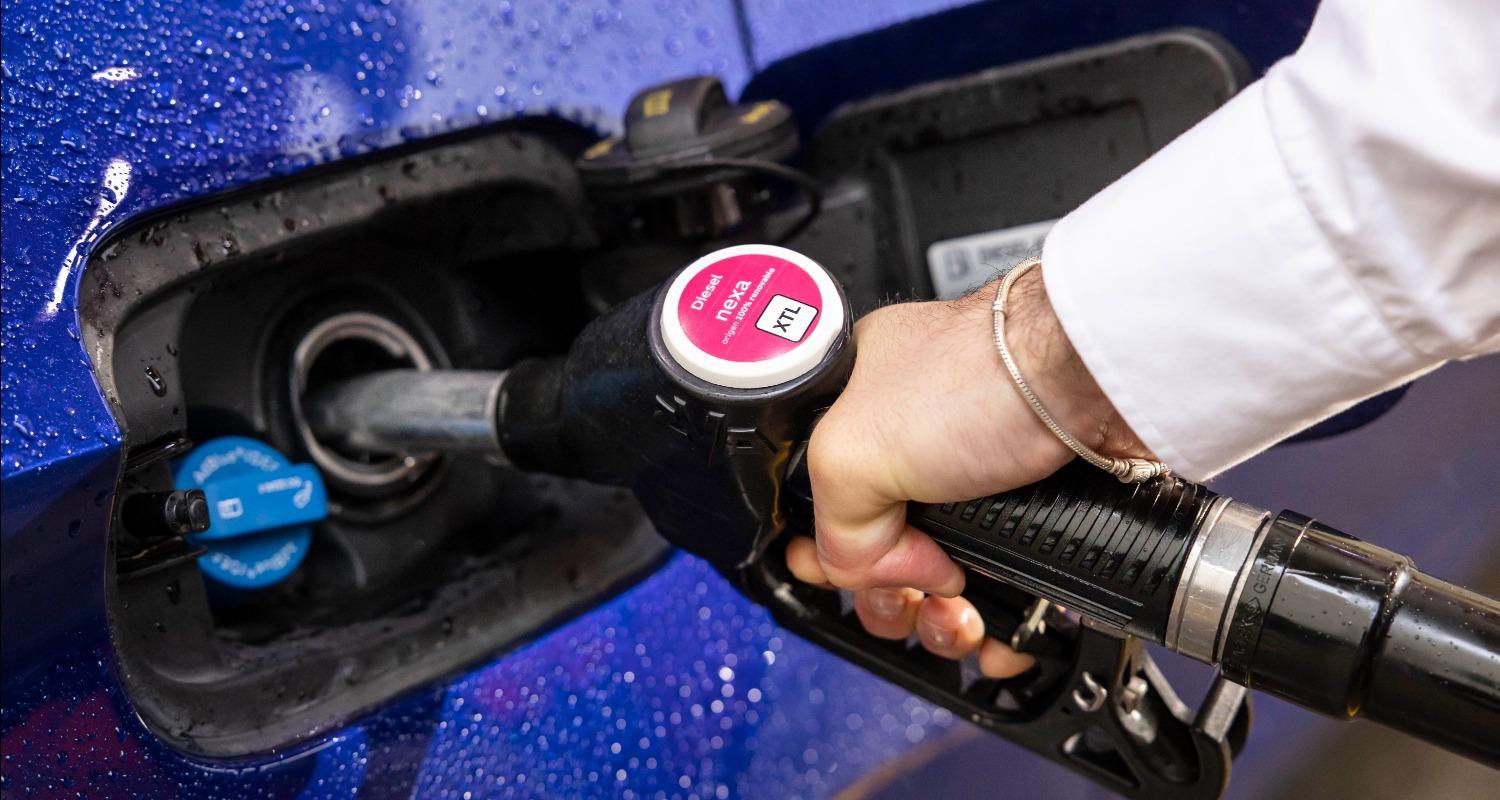
Nexa fuels from 100% renewable sources
Nexa fuels from 100% renewable sources
What they are, how much they reduce emissions, and whether you can use them in your vehicle
What they are, how much they reduce emissions, and whether you can use them in your vehicle
Renewable fuels are liquid fuels made from raw materials of renewable origin. In Repsol's Nexa range of 100% renewable origin, 100% renewable-sourced Nexa Diesel is compatible with all diesel engines and Nexa Gasoline 95 of 100% renewable origin is compatible with gasoline or hybrid vehicles, without the need to modify the engine. The reduction in emissions is calculated considering the entire life cycle: up to 90% for diesel and more than 70% for gasoline compared to their fossil-based equivalents. It does not mean zero exhaust pipe emissions.

Senior Manager of Energy Products for Mobility
You reach the pump at the service station and read, “100% renewable origin.” Given this message, it is logical to ask yourself if this product is suitable for your car. Studies indicate that two out of every three people would be willing to use it, but first they demand clear answers.
In this article we answer those questions, also clarifying whether these fuels are reliable, whether they are really available on a large scale and how much they reduce emissions.
What is a 100% renewable fuel?
What is a 100% renewable fuel?
In practical terms for the driver, a renewable source fuel is a fuel equal to conventional ones. The difference is that they are produced from raw materials of renewable origin, which are given a second life and reduce CO2 emissions. It is the same solution as the electric vehicle in terms of CO2 emissions.
Do I have to modify my engine?
Do I have to modify my engine?
No, as long as you use the right product for your vehicle:
- Nexa diesel of 100% renewable origin: compatible with diesel combustion engines, without the need to make any modifications.
- Nexa 95 Gasoline of 100% renewable origin: Repsol declares it compatible with gasoline and hybrid vehicles, without the need to modify the engine.
Can I use renewable and conventional fuels interchangeably?
Can I use renewable and conventional fuels interchangeably?
Yes. Renewable fuels are fully compatible with fossil fuels, so you can use renewable or conventional fuel in the same vehicle, depending on your choice in each refueling. It is not necessary to make any modifications to the engine or follow a specific procedure to change from one fuel to another.
Does refueling with renewable fuel change the DGT label or affect access to a ZBE?
Does refueling with renewable fuel change the DGT label or affect access to a ZBE?
No. The DGT environmental label is assigned according to the characteristics and type approval of the vehicle, not according to the fuel that is used at a specific time. Therefore, using renewable fuel does not modify the badge or guarantee access to a Low Emission Zone. Before traveling, check the city regulations and the conditions applicable to your vehicle.
However, it should be noted that modern internal combustion engines feature very low certified emission levels, compatible with the air quality improvements targeted by Low Emission Zones (LEZs).
How can it affect the engine and its performance?
How can it affect the engine and its performance?
The Nexa range of 100% renewable origin is our highest quality fuel. The exclusive formulation of these fuels incorporates components developed by Repsol to optimize performance and help keep feed and injection systems clean. In the case of Nexa Diesel of 100% renewable origin, it stands out for its absence of aromatic compounds, a high cetane rating, anti-corrosion additives and systems to separate the water from the fuel. Helping to maintain the engine's brand-new performance.
Innovation case: HORSE H12 Concept engine
The hybrid prototype developed by Horse Powertrain and Repsol achieved a peak thermal efficiency of 44.2% and fuel consumption of less than 3.3 l/100 km in the WLTP test cycle. The 40% reduction is compared to the average for new petrol passenger cars registered in Europe in 2023. Powered by 100% renewable Nexa 95 Gasoline, it achieves net-zero operational emissions, with a footprint reduction of over 70%.
This prototype demonstrates that it is still possible to optimize internal combustion engine propulsion systems, combining efficiency and renewable fuels.
How much emissions do 100% renewable Nexa fuels reduce?
How much emissions do 100% renewable Nexa fuels reduce?
Reduction must be evaluated across the entire lifecycle: renewable raw material sourcing, processing, transport, distribution, and end use. It is not enough to just look at the tailpipe emissions.
Using this approach, Repsol reports the following net reductions compared to the equivalent fossil fuels they replace:
| Product | Net CO2 Reduction |
| Nexa Diesel 100% renewable origin | Up to 90 % |
| Nexa 95 Gasoline of 100% renewable origin | Over 70 % |
What quality and reliability guarantees do 100% renewable Nexa fuels offer?
What quality and reliability guarantees do 100% renewable Nexa fuels offer?
100% renewable Nexa fuels provide the highest guarantees of quality, reliability and performance. They strictly comply with national and international quality specifications and hold the necessary approvals and certifications to ensure safe, vehicle-compatible use. In addition, we hold European ISCC-EU certification and apply verification systems to ensure product traceability from raw maetrial origin to the pump, in complaince with the European RED Directive.
Likewise, its quality and technical compatibility are supported by international reference standards, such as those promoted by the Worldwide Fuel Charter, which establishes global recommendations for safe, reliable and suitable fuels for today's engines.
Where are they available and what is the production and deployment capacity?
Where are they available and what is the production and deployment capacity?
We currently supply 100% renewable-sourced Nexa Diesel at more than 1,600 Repsol service stations in Spain and Portugal. On an industrial scale, our Cartagena plant produces 250,000 metric tons per year, and the Puertollano facility has the capacity to contribute another 200,000 metric tons per year. We have set an industrial target to produce between 1.5 and 1.7 million metric tons by 2027, reaching 2.7 million metric tons by the end of the decade.
Currently, we supply 100% renewable Nexa diesel at over 1,600 service stations in Spain and Portugal
To ensure steady supply, we integrate this product into a large-scale logistics infrastructure, such as the 400-kilometer pipeline that connects our facilities in Cartagena and Puertollano.
The circular economy also plays a key logistical role: we have set up used cooking oil collection points at more than 750 service stations across several autonomous communities.
In this way, members of the public actively participate by contributing their own waste, which we then give a second useful life by transforming it into energy resources for transport.
Additionally, to ensure final quality and prevent fraudulent practices, we add an exclusive marker to the product that unequivocally identifies its origin.
A solution equal to electrification
A solution equal to electrification
Renewable fuels and electrification meet different needs and can complement each other. Electricity is particularly efficient for short trips, while renewable liquid fuels can reduce the carbon footprint and offer a solution tailored to each customer's needs, from road mobility to hard-to-electrify sectors such as maritime and air transport.
The choice of technology depends on individual use and needs, as well as energy efficiency, infrastructure availability, vehicle type, distance, cost, and lifecycle emissions.
Why are they relevant to the current vehicle fleet?
Why are they relevant to the current vehicle fleet?
Over 97% of the European vehicle fleet currently consist of internal combustion engine vehicles. The Spanish fleet is aging: the average age of passenger cars reached 14.6 years in 2025, and 9.28 million vehicles were over 20 years old, according to ANFAC data from the DGT. Renewable fuels allow us to address part of that existing fleet without waiting to replace all vehicles
This benefit does not replace the need to fleet renewal, but rather helps accelerate it by incorporating all available solutions. At Repsol, we are committed to a more modern, efficient fleet with a lower carbon footprint, where electrification and renewable fuels advance as equally valid alternatives depending on the vehicle, use and available infrastructure.
Ongoing challenges and European regulatory framework
Larger-scale deployment depends on the sustainable availability of raw materials, industrial capacity, costs, traceability, and stable regulations. The use of renewable raw materials must comply with sustainability, traceability and emissions reduction criteria under the European renewable energy framework, avoiding indirect impacts or competition with other priority uses.
We need a stable, long-term, and consistent regulatory framework across all sectors that puts renewable fuels on equal footing with electricity, under a technology-neutral approach. It is the only way to reach the target, enable further industrial investment, and address the remaining challenges of both renewable fuels and electrification.
In the European Union, current regulations for new passenger cars and vans maintain a target of 100% reduction in CO2 emissions for the new vehicle fleet by 2035. This regulation is under review.
The Directive that would prohibit the sale of light-duty vehicles with combustion engines is currently under review (expected by the end of the year). The publications at the end of 2025 already signalled an opening and included renewable fuels as part of the solution. Debates are currently ongoing as to how all solutions can be included under a technology-neutral approach.
Frequently asked questions about renewable fuels
No. The vehicle emits CO2 when fuel is burned. The reported reduction is net and calculated over the lifecycle compared to its fossil fuel equivalent.
It means they are produced from renewable, non-fossil raw materials that are given a second life through advanced industrial processes. The result is a liquid fuel compatible with the specified engines, capable of reducing net CO2 emissions compared to its fossil equivalent.
Because accurately assessing the climate impact of a fuel requires accounting fo all lifecycle stages: raw material origin, production, transport, distribution and end use. There are still tailpipe CO2 emissions, but the reduction is calculated on a net basis compared to the fossil fuel equivalent.
Yes. Renewable fuels and electrification are different and complementary solutions to reduce mobility emissions. Electrification will be key for many applications, and renewable fuels also enable progress in internal combustion engine vehicles, both existing and new. The energy transition does not rely on a single technology, but rather on leveraging all available options depending on vehicle type, usage, and infrastructure.
Not necessarily. Renewing the fleet means moving toward more modern, efficient vehicles with a lower carbon footprint. That renewal can include electric vehicles, hybrids, and also more efficient internal combustion vehicles capable of using renewable fuels. The priority is to reduce emissions using the most suitable solution for each application.
No. They can also contribute to fleet renewal by enabling the use of new, more efficient internal combustion vehicles with a lower carbon footprint. Their advantage is that they can help reduce emissions today in compatible vehicles, without limiting the transition to a single technology.
Yes, if you choose the product compatible with your engine. Nexa Diesel is suitable for diesel engines; while Nexa Gasoline 95 is designed for gasoline or hybrid vehicles.
Yes. You can alternate or mix them in the fuel tank without a special procedure, as long as both are the right type for the vehicle.
No. The DGT environmental badge depends on the vehicle and its approval, not on the fuel type.
Use the official Repsol search engine and filter by product type: Nexa Diesel or Nexa 95 Gasoline of 100% renewable origin.
Yes, at certain collection points. Check availability in advance using the search engine or the Waylet app.
The price of 100% renewable source fuels, such as our Nexa product, is aligned with premium fuel market prices.
Pricing may vary depending on the station, date, and available promotions. Check the station search engine or Waylet app before refueling.
¿Quieres estar al día sobre las tendencias que definirán el futuro?
¡No te quedes atrás! Únete a miles de personas que descubren cada mes nuevos contenidos sobre energía, tecnología y hogar.
¿Quieres estar al día sobre las tendencias que definirán el futuro?