
Pumped hydropower storage
Pumped hydropower storage
A key solution for managing electricity demand
A key solution for managing electricity demand

Deputy director of the Aguayo Project
According to the International Energy Agency (IEA), hydropower storage is the most effective industrial-scale solution available for storing electricity, accounting for over 90% of the world's installed energy storage capacity.
In the municipality of San Miguel de Aguayo, in the region of Cantabria in northern Spain, an infrastructure that has been operating since 1982 is about to quadruple its capacity. Aguayo II is the expansion project for the Aguayo reversible pumping station, which will increase from 360 MW to approximately 1,400 MW of installed capacity to make it the second-largest pumping station in Spain. Recognized by the European Union as a Project of Common Interest and supported with €180 million from the Connecting Europe Facility, the entire project will be executed underground, without altering the landscape.
How hydropower is stored: all the mechanisms, step-by-step
How hydropower is stored: all the mechanisms, step-by-step
Pumped hydropower storage is a technology that stores electrical energy by holding water at a higher elevation until the electrical system needs it, at which point it is released and converted back into electricity. It is, in essence, a large-scale natural battery.
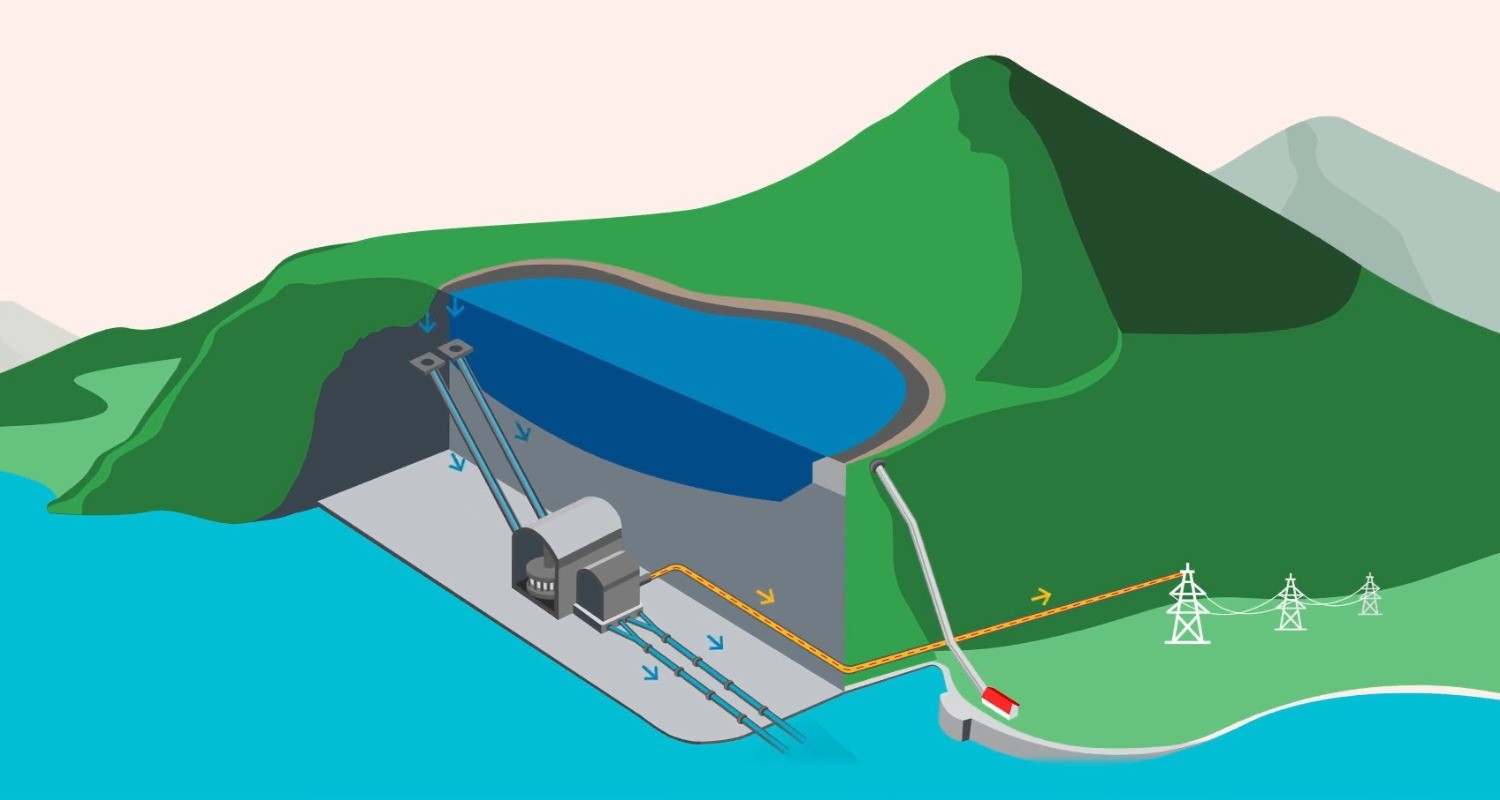
Its operation is based on two reservoirs located at different heights, connected by a penstock (an enclosed pipe) and equipped with reversible turbines:
- When there is surplus electricity in the grid — for example, at noon when solar production is massive — that excess energy is used to pump water from the lower reservoir to the upper reservoir.
- When electricity demand rises, the water in the upper reservoir is released and it flows down the penstock to the turbines, where it generates an immediate and stable supply of electrical energy.
It's just like charging a battery: electricity is stored in the form of elevated water, and the water released from the upper reservoir is like the battery discharge. But in the case of pumped hydropower, it's gravity doing the work. There's no chemical reaction, no degradation, and no expiration date.
What makes this technology especially valuable is its dual purpose. Reversible hydraulic units serve as pumps when there is a surplus by storing energy and as turbines when there's demand by generating electricity. The same machine does both jobs, adapting in real time to what the system needs at any given moment.
We can add to this the speed of response: a pumping station can start and supply power in a matter of minutes, and even help restart the power grid after a total power outage, which is a procedure known as a black start. In terms of durability, pumped hydropower facilities can run for decades, with life cycles far exceeding those of other storage technologies, such as lithium-ion batteries.
Transmission and storage of hydropower take place in two separate but complementary areas. One is the transfer of water: penstocks and other conduits move water between the two reservoirs, whether pumping upward or flowing downward for generation. The other is electricity transmission: once generated in the hydropower plant, the electricity is sent to the transformers where its voltage is increased and transferred to the high-voltage power transmission lines that take it to the point of consumption. Storage, on the other hand, takes place in the upper reservoir itself, in the form of potential energy, waiting for the grid to need it.
According to the Ministry for the Ecological Transition and the Demographic Challenge, pumped hydropower plants are net consumers of electrical energy: they consume more electricity during pumping than they generate when water is released, entailing a loss in the process. Their value, however, lies not in gross energy efficiency but in the service they provide to the grid as a whole: capacity to store and regulate supply, shoring up supply security, and offering flexibility to integrate renewables.
This technology a key piece among the various energy storage solutions that Repsol is developing as part of our commitment to low-carbon generation.
The problem of storage: why saving energy is so complex
The problem of storage: why saving energy is so complex
The electrical system works on a principle of physics: the energy produced must be either consumed at that very moment or stored. There are no other options in this regard. Any imbalance between production and consumption affects the frequency and stability of the grid, with direct consequences for supply.
Renewable sources such as solar or wind generate electricity when there is sun or wind, not necessarily when there is demand. So, it's not a matter of whether they are capable of producing energy but what happens to that energy when the system does not need it at that precise moment.
To understand the scale of the challenge, think about what happens when you open the faucet and the water flows without anyone using it... it goes down the drain. The same thing happens with electricity, but without an actual drain. If there's no way to store electricity at the moment it is produced, it disappears. The difference is that you can't just turn off the faucet, because suddenly disconnecting a generation source affects the balance of the entire network.
A mature and effective solution: hydraulic storage
A mature and effective solution: hydraulic storage
When there is surplus electricity on the grid, that energy is used to pump water from the lower reservoir to another at a higher elevation. When the power demand rises, the water is allowed to flow downward, moving the turbine blades and generating an immediate and stable supply of electricity. The principle is so simple that it is hard to believe that it's the most effective solution in the world for storing energy on an industrial scale.
Hydraulic pumping accounts for more than 90% of the world's installed energy storage capacity.
It's just like charging a battery: electricity is stored in the form of elevated water, and the water released from the upper reservoir is like the battery discharge. But in the case of pumped hydropower, it's gravity doing the work. There's no chemical reaction, no degradation, and no expiration date. Physics is as simple as it is productive.
What makes this technology especially valuable is its dual purpose. Reversible hydraulic units serve as pumps when there is a surplus by storing energy and as turbines when there's demand by generating electricity. The same machine does both jobs, adapting in real time to what the system needs at any given moment.
We can add to this the speed of response: a pumping station can start and supply power in a matter of minutes, and even help restart the power grid after a total power outage, which is a procedure known as a black start.
In terms of durability, the advantage is even clearer. Pumped hydropower facilities can run for decades, with life cycles far exceeding those of other storage technologies. According to the IEA, Europe currently has 215 TWh of hydroelectric storage. In Spain, the 2025 Electricity System Report published by the national grid operator, Red Eléctrica, backs up this figure with data: of Spain's 3,427 MW of total installed storage capacity, 3,331 MW correspond to pumped turbines and only 96 MW belong to batteries. However, both technologies do not compete: they complement one another. Batteries are best for short-term storage, while pumped hydropower lets us achieve seasonal storage and provides structural stability to the system.
Aguayo: four decades of hydraulic storage in Cantabria
Aguayo: four decades of hydraulic storage in Cantabria
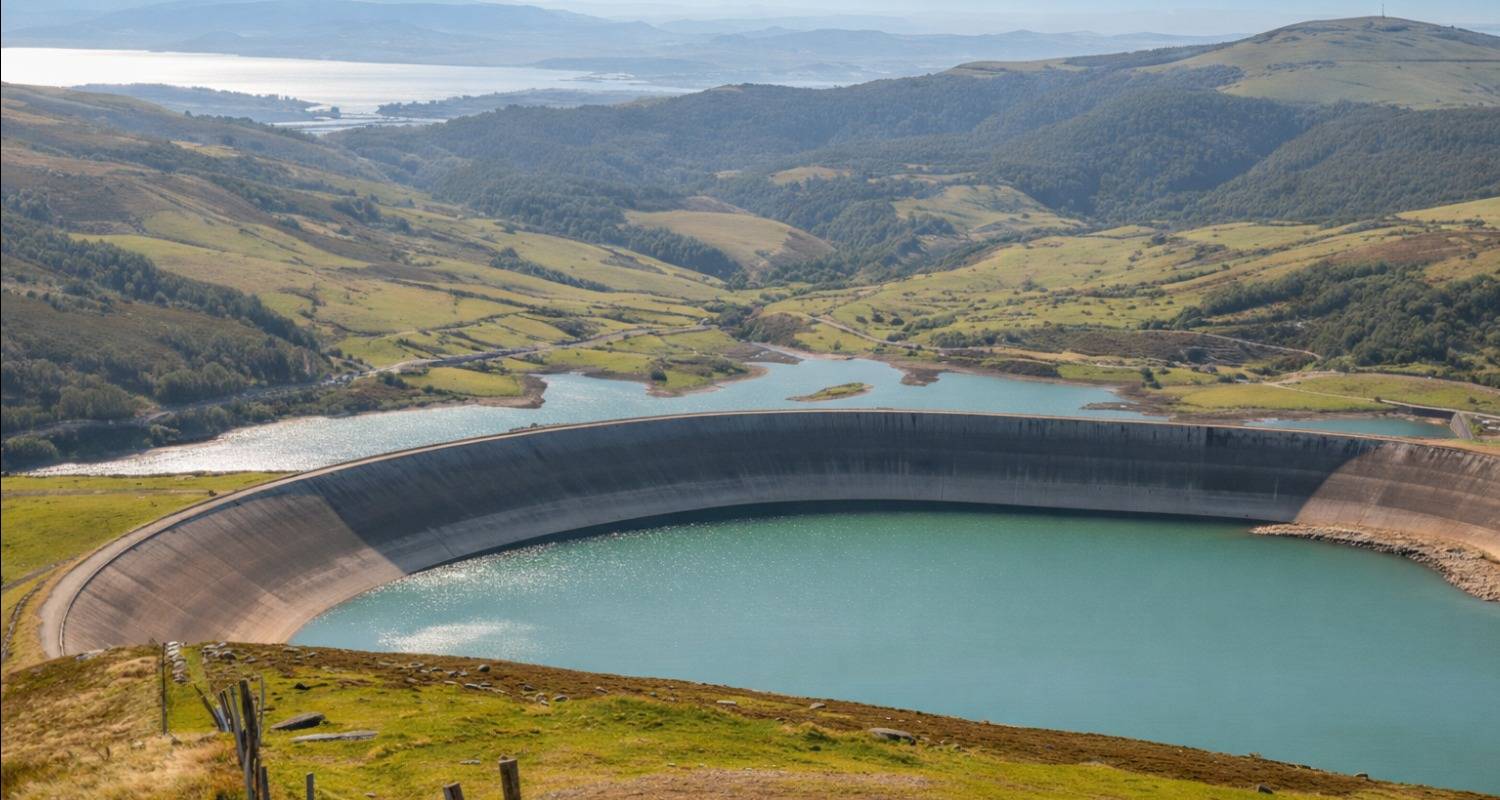
The Aguayo reversible pumping station has 360 MW of installed capacity and an average annual production of 700 GWh. It uses the Alsa reservoir as the lower reservoir and the Mediajo reservoir as the upper reservoir: the two "terminals" of this natural battery.
Its role in the electrical system doesn't stop at electricity generation. It brings flexibility to the system, stabilizes frequency and the voltage of the grid, and acts as a firm backup in the event of sudden load or generation variations. Its synchronous technology contributes inertia to the system, acting as a buffer against the imbalances introduced by variable generation.
In energy terms, Aguayo acts as insurance: it absorbs the excess when there is surplus generation, releases stored energy when demand rises, and can respond to any system failure.
Aguayo II: multiplying capacity without moving mountains
Aguayo II: multiplying capacity without moving mountains
The Aguayo II expansion project radically multiplies the capacity of this infrastructure. The installed capacity will increase from the current 360 MW to approximately 1,400 MW in total: nearly four times more, making it the second-largest pumped hydropower station in Spain.
Planned production will be around 2,000 GWh per year, enough to supply more than 800,000 households, making Aguayo the second largest pumping plant in Spain.
All the expansion work is underground and the mountain will remains the same: what changes is its capacity to store energy for hundreds of thousands of homes
And here the key to the project: all the work will take place underground. New pipelines and turbines will be installed inside the mountain, without significantly modifying the existing reservoirs and without generating any visual impact. This is the solution that will multiply capacity without altering the landscape. There's no need to move mountains to achieve this leap in capacity: what changes happens underneath.
|
Aspect |
Value |
|
Current power (Aguayo II) |
360 MW |
|
Total power after expansion |
~ 1,400 MW |
|
Planned production |
~2,000 GWh/year |
|
Homes supplied with power |
Over 800,000 |
|
Total investment: |
~ €900 B |
|
Direct on-site employment (peak) |
~ 1,000 people |
|
Time of construction |
Over 4 years |
|
European Funding (EEC) |
€180 M |
|
Construction method |
Entirely underground |
Beyond the infrastructure itself, the expansion will have a direct economic impact on the region of Cantabria as the around €900 million being invested in the project will activate local supply chains and lay the foundation in terms of energy for industrial development in the region.
European recognition: a Project of Common Interest
European recognition: a Project of Common Interest
Since 2023, the expansion of Aguayo has been recognized as a Project of Common Interest (PCI) by the European Union, a category reserved for key infrastructures for European energy integration: projects that contribute to the interoperability of networks, the security of supply, and the reduction of CO₂ emissions.
In addition, the initiative has received €180 million from the Connecting Europe Facility (CEF), a European funding line that prioritizes strategic projects in energy, transportation, and digital infrastructure.
Aguayo II has EU recognition as a Project of Common Interest and €180 million through the CEF facility: direct EU expansion of the expansion project
This European backing underlines something that is sometimes lost in the energy debate: large-scale storage is not a complement to the system, it is a condition for it to work. Without the capacity to store surplus renewable generation, the energy transition loses its operational base.
Spain, with its mountainous terrain and its existing hydropower facilities, is uniquely positioned to take advantage of this potential. As for Aguayo, it's an example of how to expand an existing infrastructure's contribution with the least possible impact.
Hydraulic energy storage capacity in Spain
Hydraulic energy storage capacity in Spain
The 2025 Electricity System Report published by Spain's national grid operator, Red Eléctrica, backs up this figure with data: of Spain's 3,427 MW of total installed storage capacity, 3,331 MW correspond to pumped turbines and only 96 MW belong to batteries. However, both technologies do not compete: they complement one another. Batteries are best for short-term storage, while pumped hydropower lets us achieve seasonal storage and provides structural stability to the system.
The National Integrated Energy and Climate Plan (PNIEC) sets the goal of reaching 22.5 GW of installed storage capacity in Spain by 2030, combining pumping, batteries, and other technologies. Energy companies such as Repsol have up to 40 pumping projects underway in different phases of development, which could add an additional 15,000 MW of capacity.
Spain, with its mountainous terrain and its existing hydropower facilities, is uniquely positioned to take advantage of this potential. As for Aguayo, it's an example of how to expand an existing infrastructure's contribution with the least possible impact instead of building a whole new facility.
Aguayo II is part of Repsol's energy transition and sustainability strategy, which promotes renewable energy projects through Repsol Renovables in different parts of Spain.
The energy we don't see but which powers everything
The energy we don't see but which powers everything
When we turn on the light or charge the phone, we don't think about where that energy was 10 minutes ago. It could have been in the Mediajo reservoir in the form of elevated water, waiting for the moment when the grid needed it.
That's hydraulic storage: the silent guarantee that energy generated by wind or the sun is available when we need it, not just when nature produces it.
Aguayo has been demonstrating this technology's reliability for four decades. And with the expansion underway, it will do so on a scale that places it among the most relevant energy infrastructures in southern Europe.
FAQs about Aguayo II and pumped hydropower storage
FAQs about Aguayo II and pumped hydropower storage
What is pumped hydropower storage?
Pumped hydropower storage is a technology that stores electrical energy by holding water at a higher elevation. When there is surplus electricity on the grid, that energy is used to pump water from the lower reservoir to another at a higher elevation. When the power demand rises, the water is allowed to flow downward, moving the turbine blades and generating electricity immediately. It is, in essence, a large-scale natural battery that doesn't degrade and has no expiration date.
What are the forms of transmission and storage of hydropower?
Transmission and storage of hydropower take place in two separate but complementary areas. Penstocks and other conduits move water between the two reservoirs, whether pumping upward or flowing downward for generation. Once generated in the hydropower plant, the electricity is transferred to the high-voltage power transmission lines that take it to the point of consumption. Storage itself takes place in the upper reservoir itself, in the form of potential energy, waiting for the grid to need it.
What is Aguayo II and what does the expansion project involve?
Aguayo II is the expansion project for the Aguayo reversible pumping station in Cantabria, operational since 1982. The expansion will multiply its installed capacity from 360 MW to approximately 1,400 MW, making it the second largest pumping station in Spain, with an expected production of 2,000 GWh per year capable of supplying more than 800,000 homes.
How much energy can Spain store with hydraulic pumping?
The 2025 Electricity System Report published by Spain's national grid operator, Red Eléctrica, backs up this figure with data: of Spain's 3,427 MW of total installed storage capacity, 3,331 MW correspond to pumped turbines. The PNIEC sets the goal of reaching 22.5 GW of total storage capacity by 2030.
What does it mean that a project is "of Common Interest" for the European Union?
A Project of Common Interest (PCI) is a category reserved by the European Union for infrastructures that are key to the continent's energy integration. These projects contribute to the interoperability of electricity networks, security of supply, and the reduction of CO₂ emissions, and often have access to specific European funding, such as the Connecting Europe Facility.
How is hydraulic pumping different from batteries?
Hydraulic pumping is geared towards seasonal and high-volume storage, with a lifespan of several decades and no significant degradation. Batteries are more effective for short-term storage. In Spain, both technologies complement one another: pumped hydro makes up 3,331 MW of the 3,427 MW of installed storage, while batteries cover more immediate response needs.
When will the expansion of Aguayo II be completed?
The construction of Aguayo II is expected to last more than four years, with a total investment of approximately €900 million and a peak of direct employment on-site of around 1,000 people.

-scr.jpg)